
Water Rocket

  • Water Rocket Aerodynamics aims to introduce students to the fundamental principles of flight through a simple, safe, and exciting hands-on activity. The theme emphasizes how water and air pressure work together to generate thrust, allowing the rocket to accelerate and travel across a horizontal path. By experimenting with water levels, pressure variations, and launcher positioning, students gain a strong foundational understanding of propulsion systems and real-world physics.
  • A major focus of this theme is learning how rocket design directly affects stability and distance. Students explore how streamlined shapes reduce drag, how nose cones influence airflow, and how proper fin alignment keeps the rocket travelling in a straight line. The importance of balancing the rocket’s center of gravity and center of pressure is also highlighted, helping young learners understand why professional rockets require precise structural design.
  • Beyond scientific concepts, this theme promotes creativity, teamwork, and eco-friendly engineering. Students build their models using recyclable plastic bottles, safe materials, and clean propellant without chemicals or combustion. Through testing, observing, and improving their rockets, participants develop problem-solving skills and confidence in applying theoretical knowledge to practical challenges—making the water rocket challenge both educational and enjoyable.

Objective

Students should build a water rocket model using plastic bottles and safe materials, which can be launched using air pressure and must travel maximum horizontal distance in a straight path.

General Rules:

  • Each team should consist of 3 students.
  • A team should have students only from Grades 6 to 9.
  • The rocket should be made using only plastic bottles (max 2 liters) and safe materials such as cardboard fins, plastic cones, tapes etc.
  • Only water may be used as propellant, and air pressure will be provided using the standard event launcher
  • No chemical propellants, flammable materials or metal components allowed.
  • The rocket must travel within the designated horizontal launch lane.

    Robot Dimension (Max): Length x Breadth x Height = 45cm x 35cm x No Limit

Game Rules:

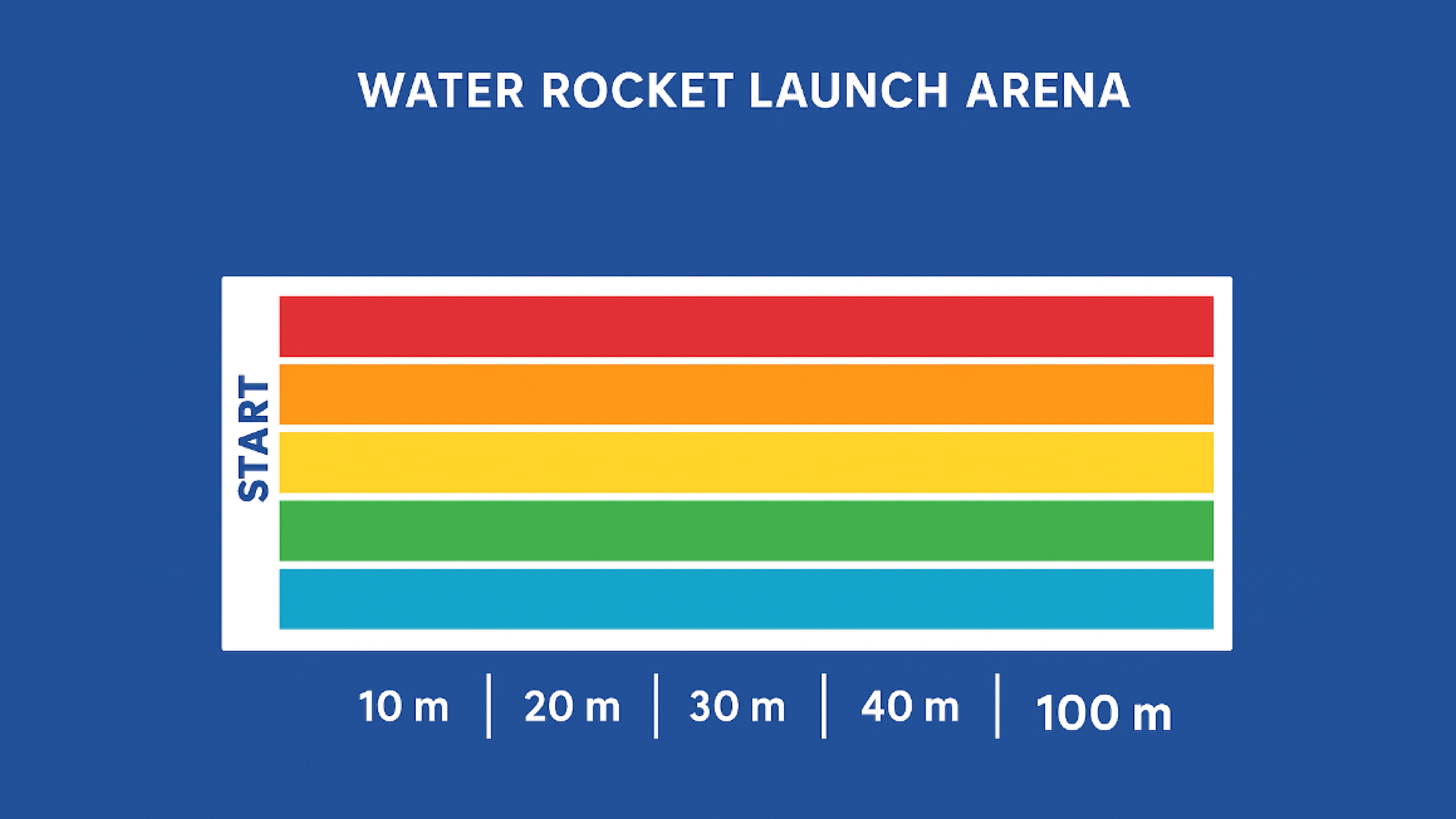
In this category, students should build a water-powered rocket made using plastic bottles and safe materials. The rocket should be able to launch using air pressure and travel the maximum horizontal distance inside the designated launch lane. The performance of the rocket will depend on its aerodynamics, design stability, water level, and launch angle. After filling water at the Water Fill Station, the rocket must be placed on the official launcher, and the team should aim for a stable and well-directed flight.
Prelims:

In the prelims round, all teams must launch their water rockets to achieve maximum horizontal distance in the Straight Launch Lane.

  • The rocket must be placed at the Launch Zone and launched only using the official event launcher.
  • Teams must fill water only at the Water Fill Station before the attempt.
  • Each team will get ONE launch attempt in the prelims.
  • The objective is to ensure the rocket travels the maximum possible horizontal distance within the marked lane.
  • The rocket must remain inside the designated flight corridor throughout the launch.
  • The rocket’s distance will be measured from the Launch Line to the first point of ground impact.
  • Total time for preparation is 3 minutes.
  • Launch begins only after the referee whistle.
  • Touching the launcher after the whistle or influencing the rocket physically is strictly prohibited.
  • Judges’ decision will be final.

Finals:

Only the shortlisted teams from the prelims will compete in the finals.

  • Each team will get TWO launch attempts in the finals.
  • Best of the two distances will be considered for scoring.
  • In finals, the rocket must be launched at two different angles:
    • Attempt 1 → Low angle (30°–45°)
    • Attempt 2 → High angle (50°–60°)
  • The rocket must remain stable during flight and must land inside the marked lane.
  • Negative points:
    • For deviation from lane
    • For unsafe design
    • For breakage upon launch
  • Total time for setup: 4 minutes per attempt.
  • The game starts once the referee gives the whistle.
  • Judge’s decision will be final.