
Zero Pollution

ZERO POLLUTION: Pollution is one of the significant threats to the environment, agriculture fields, impacting soil fertility, and water quality and crop productivity. Air pollution from industries and vehicles in a developing cities releases harmful gases such as sulfur dioxide and nitrogen oxides which leads to severe health illness for human beings. Creating ample green spaces such as parks and gardens inside the city limit will helps to balance the pollution caused by the carbon emission. Soil pollution is majorly caused by releasing toxic substances, hazardous materials, and non-bio degradable substances to the soil field. This contaminated soil affects water quality through runoff, leading to dry moisture level in the soil which affects its fertility. For any sustainable city, clean air ensures the healthy respiration and improves overall well-being, while clean soil and water ensure sustainable farming practices. Pollution-control measures are essential for restoring ecological balance and fostering resilient urban ecosystems. Innovative solutions such as automation and robotics offer effective ways to control pollution. Automated systems can plant trees in heavily polluted areas, helping absorb harmful gases and improve air quality. Robots equipped with sensors can monitor air quality, soil health, enabling precision agriculture to minimize chemical use and restore degraded lands.

Objective

Students should build a wireless remote controlled movable robot, which can able to perform the given task within a specific time.

General Rules:

  • Each team should consist of 3 students.
  • A team should have students only from Grades 7 to 9.
  • The Robot should be designed as per the given dimension and perform the complete task within the given time.                 


    Robot Dimension (Max): Length x Breadth x Height = 35cm x 35cm x No Limit

Game Rules:

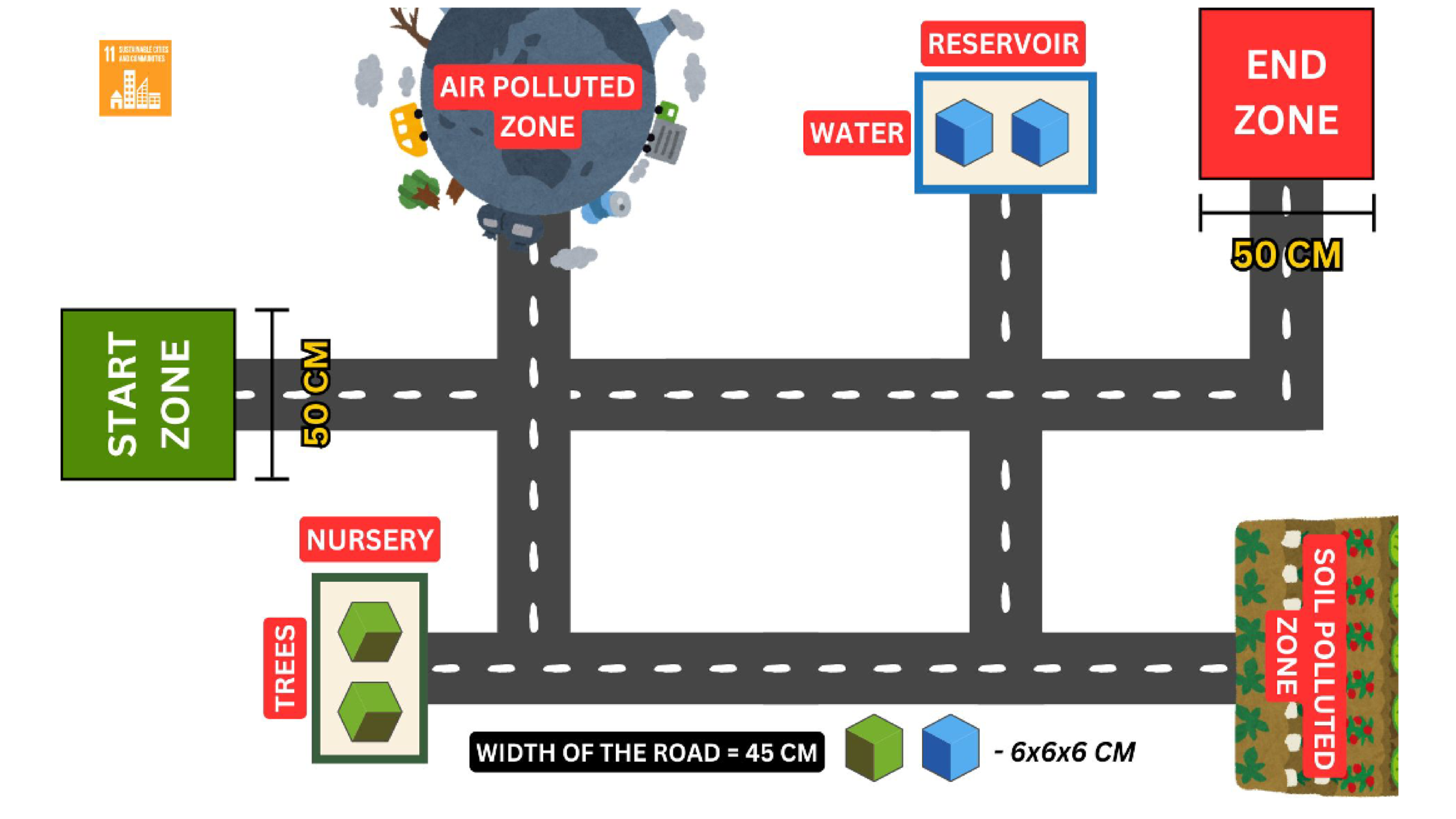
In this category, students should build a wireless remote-controlled robot which can move in the arena and perform the pollution management tasks like monitoring the quality of the air in the air polluted zone and quality of the soil in the soil polluted zone. Trees and water should be placed in the polluted zones based on the environmental quality in the respective zones. The robot can either grab/drag the trees or water from its place to the polluted zones.

Zero Pollution Maze:

Zero Pollution Car Maze is an eco-themed robotics challenge where students navigate a miniature electric or renewable-energy-powered car through a specially designed maze that represents real-world environmental zones affected by pollution. The task tests precision, path-planning, and problem-solving as the car must avoid “polluted” areas, take the cleanest possible route, and reach the final destination with zero emissions. The arena encourages awareness of sustainable mobility by rewarding energy efficiency, accurate turns, and smooth navigation, making it both a fun and educational event promoting green technology.
Prelims:

  • Each team will get a chance to choose their task by a lot shuffling method before their round begins (Two color blocks; Green and blue will be placed inside the box and shuffled. One member from a team should pick a block from the box, based on the chosen color block; the team should perform that particular task alone).
  • Participants should build only a wireless robot for this category, No wired robot is allowed in this category.
  • Robot should start from the Start zone and reach their chosen polluted zone first. Once reaching the polluted zone, the robot should sense the quality of that zone.
  • Quality of the air inside the air polluted zone.
  • Water moisture level in the soil polluted zone.
  • Participants need to measure the quality of that particular zone in the form of analog signal and display the value in their mobile application/laptop/any remote devices (The displaying feature must not be on-boarded in the robot).

Case 1 – AIR POLLUTION ZONE:

  1. If the sensor value is between 0 and 500 (analog value), it shows the air quality is low and the place is considered as Highly Polluted Zone. In such case, participants need to plant 2 Trees (Green blocks) from the nursery zone to the air polluted zone. Robot can move the blocks one by one or both together based on their preference.
  2. If the sensor value is above 500 (analog value), it shows the air quality is moderate and the place is considered as Less Polluted Zone. In such case, participants need to plant 1 Tree (Green block) from the nursery to the air polluted zone.

Case 2 – SOIL POLLUTION ZONE:

  1. If the sensor value is between 0 and 500 (analog value), it shows the moisture lever is low and the soil is considered as Highly Polluted. In such case, participants need to deliver 2 water blocks (Blue Color) from the reservoir to the soil polluted zone. Robot can move blocks one by one or both together based on their preference.
  2. If the sensor value is above 500 (analog value), it shows the soil moisture is moderate and the place is considered as Less Polluted Zone. In such case, participants need to deliver 1 Water Block (Blue Color) from the reservoir to the soil polluted zone.
  • Once the task is completed, the robot must be completely parked inside the END Zone.
  • The robot must not be touched at any point of time during the task except inside the soil polluted zone. Participants are allowed to adjust the soil moisture sensor manually while measuring the moisture level of the soil inside the soil polluted zone.
  • Total time for the task is 5 minutes.
  • The game starts once referee gives the whistle.
  • Judges decision will be the final.

Finals:

  • Only the shortlisted team from the prelims will be moved to final
  • In the final round, the robot must perform both the tasks starting from start zone and reach the air polluted zone where it will measure the quality of air, and display its analog value in the mobile application/laptop.
  • Based on the range of analog value it has to place the number of tree blocks from the nursery to the air polluted zone.
  • After completing the task it has to reach the soil polluted zone and measure the soil quality (moisture level) and displays its analog value in the mobile application/laptop.
  • Based on the range of analog value it has to place the number of water blocks from the reservoir to the soil polluted zone.
  • Once both the tasks are completed, the robot must be completely parked inside the END Zone.
  • Total time for the task is 7 minutes.
  • The game starts once referee gives the whistle.
  • Touching the robot in middle of the game is strictly prohibited.
  • Judges’ decision will be the final.